
The braces are off, the aligners are finished, and the teeth look the way they were supposed to. Then, a few years later, one of the lower front teeth begins to turn. Since wisdom teeth often start causing trouble around the same age, they are an easy suspect.
Wisdom teeth can cause pain, swelling, infection, and damage near the back of the mouth. In certain cases, they may also add pressure in an arch that already has very little room. However, they are not usually the main reason straightened teeth begin moving again.
Post-treatment shifting has several possible causes, including inconsistent retainer wear, continued jaw growth, changes in the bite, and the natural tendency of teeth to move with age. Removing wisdom teeth does not prevent all of those forces. Likewise, keeping them does not guarantee that orthodontic treatment will be undone.
At Growing Smiles Pediatric and Family Dentistry, our team serves patients in Voorhees, Cherry Hill, and Mount Laurel, NJ. We can examine developing wisdom teeth, check a retainer that no longer fits, and determine whether the two concerns are connected.
Why Wisdom Teeth Often Get Blamed
Wisdom teeth usually become noticeable during the late teen years or early adulthood. Lower front teeth also commonly begin showing small alignment changes during this period. When both happen within a few years of each other, it can look as though the wisdom teeth pushed the entire row forward.
The idea makes sense at first glance. A wisdom tooth develops behind the other molars, space is limited, and the front teeth appear more crowded. The jaw, though, is not a row of blocks where pressure at one end moves everything neatly toward the other.
Teeth respond to several forces at once. The lips, tongue, bite, jaw growth, bone, and gum tissue all affect their position. Even people who never develop wisdom teeth can notice crowding in the lower front teeth as they get older.
Can Wisdom Teeth Cause Crowding?
They may contribute in some cases, particularly when the lower jaw has very little available space. A developing or erupting wisdom tooth can create pressure near the back molars, and some research has found a possible association with changes in the lower dental arch. However, the effect is not consistent enough to explain most orthodontic relapse by itself.
A 2023 systematic review found that most included studies did not show a significant connection between lower wisdom teeth and crowding after orthodontic treatment. The authors could not completely rule out a smaller influence, partly because the available studies varied in quality and design. In other words, wisdom teeth may be one piece of the picture, but the evidence does not support treating them as the main culprit in every case.
In a narrow lower arch, several things may be happening at once. A retainer may no longer be worn regularly, the bite may be settling, and the front teeth may already have very little space. If wisdom teeth are developing during the same period, their effect can be difficult to separate from those other changes.
Wisdom Teeth Can Still Cause Real Problems
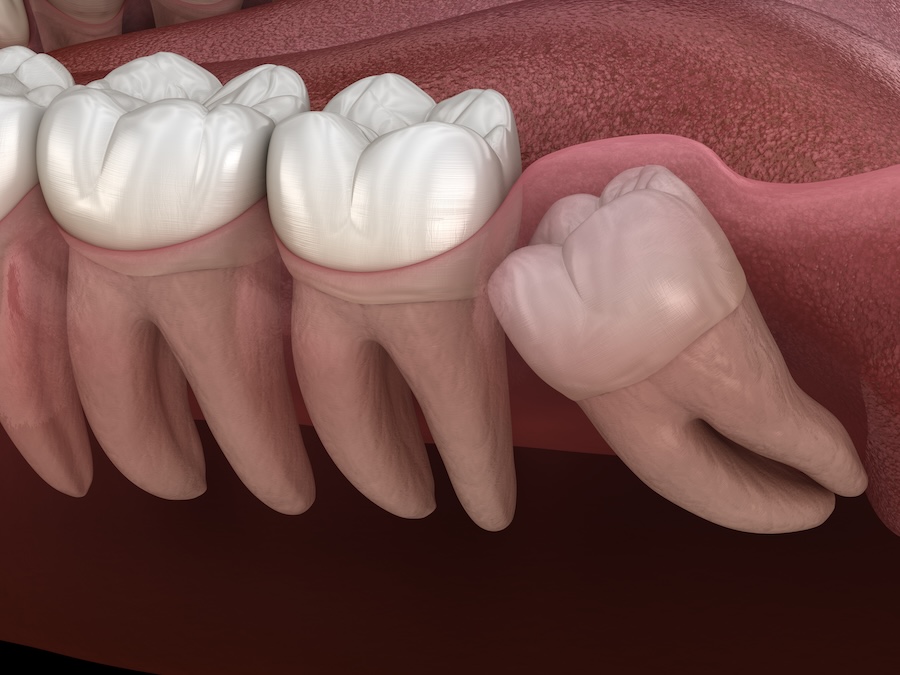
Although they are often blamed too broadly for front-tooth crowding, wisdom teeth can create problems of their own. An impacted tooth may press against the second molar, remain trapped beneath the gum, or erupt only partway. That area can become painful and difficult to clean.
Partially erupted wisdom teeth often leave a flap of gum where food and bacteria collect. The tissue may swell, bleed, or become tender, and some patients notice a bad taste when the area flares. Pain can also spread through the back of the jaw, making it difficult to tell exactly which tooth is involved.
Impacted wisdom teeth may also contribute to decay, gum disease, infection, cyst formation, or damage to the neighboring molar. Those are valid reasons to discuss removal, even when the front teeth remain straight.
What Wisdom Tooth Pain May Feel Like
Wisdom tooth discomfort usually begins near the back of the mouth rather than around the front teeth. The gum behind the last molar may feel sore, swollen, or difficult to brush. Chewing on that side can become uncomfortable, especially when food presses against irritated tissue.
Some patients feel pressure in the jaw or have trouble opening their mouth fully. Others notice swelling, bad breath, or an unpleasant taste that improves and then returns. Pain may also radiate toward the ear or along the side of the face.
These symptoms do not prove that the tooth needs to come out, but they deserve an examination. A cavity in the second molar, a gum infection, or another dental problem can feel similar. X-rays help show whether the wisdom tooth is erupting normally, trapped, or affecting the tooth in front of it.
Why Teeth Shift After Braces or Aligners
Orthodontic treatment moves teeth through the surrounding bone. Once braces or aligners are finished, the bone and supporting fibers need time to reorganize around the new positions. During that period, the teeth have a tendency to drift back toward where they started.
Movement can continue later as well. The jaws change with age, the bite settles, and the lower front teeth may gradually lose a small amount of space. Grinding, gum disease, missing teeth, and pressure from the lips or tongue can add to that change.
Lower incisors are especially likely to crowd because they are small and sit along a curved part of the arch. A tiny loss of space can rotate one tooth or push it slightly behind another. This happens in people who have wisdom teeth, people who had them removed, and people who never developed them.
Retainers Have a Larger Role in Keeping Teeth Straight
Retainers hold the teeth after active orthodontic treatment ends. At first, they support the teeth while the surrounding tissues adjust. Later, they help limit the gradual movement that can continue throughout adulthood.
A removable retainer only works while it is being worn. Many patients begin with full-time use and later move to nighttime wear, depending on the instructions they received. When wear becomes less frequent, the first clue may be a retainer that feels tighter than it used to.
Bonded retainers can help hold the lower front teeth, but they also need attention. A section of wire may loosen from one tooth while remaining attached to the others. That tooth can begin moving before the broken bond is easy to see.
Wisdom tooth removal does not replace retention. Even after all four wisdom teeth are gone, the front teeth can still shift without a retainer. Keeping the result usually depends more on long-term retention than on whether third molars are present.
What to Do When a Retainer Feels Tight
A tight retainer often means the teeth have moved slightly. If it still seats completely and does not cause strong pain, the dental or orthodontic team may recommend wearing it more consistently. However, it should not be forced over teeth that have moved enough to prevent a proper fit.
Forcing a retainer can damage the appliance or place uneven pressure on the teeth. Heating, trimming, or bending it at home can also make it unusable. Bring the retainer to the appointment so the team can see where it no longer fits.
A small amount of movement may be managed with a replacement retainer or limited orthodontic treatment. If several teeth have shifted, a short course of braces or clear aligners may be needed. After correction, a new retention plan can help hold the result.
When Wisdom Teeth May Need Removal
Removal may be recommended when a wisdom tooth is painful, infected, decayed, or damaging the molar in front of it. A tooth that repeatedly traps food beneath swollen gum tissue may also become difficult to manage. In these situations, the concern is the health of the wisdom tooth and nearby structures.
An angled wisdom tooth can create a narrow space against the second molar that is nearly impossible to clean. Decay or bone loss may begin where the two teeth meet, sometimes before the patient feels much discomfort. X-rays can reveal those changes while treatment is still being planned.
Some impacted teeth remain quiet for years and can be monitored. Others show changes before they cause obvious symptoms. The recommendation depends on the tooth’s position, available space, root development, age of the patient, and condition of the surrounding teeth.
When Wisdom Teeth May Be Left Alone
Some wisdom teeth erupt into a healthy position and can be brushed and flossed normally. Others remain beneath the gum without causing pain, infection, or damage. Those teeth may not need immediate removal.
Monitoring usually includes dental exams and periodic X-rays. The team may watch for changes in position, decay, gum pockets, cysts, or damage to the second molar. A tooth that is healthy today can be reassessed later if the surrounding conditions change.
Wisdom teeth sit far enough back that cleaning them can be difficult, even when they have erupted normally. During regular visits, the dentist can check whether plaque, decay, or gum inflammation is beginning around them. If they remain healthy and functional, removal may offer little benefit.
Should Wisdom Teeth Be Removed to Protect Orthodontic Results?
Removing healthy, symptom-free wisdom teeth only to prevent front-tooth crowding is not a reliable substitute for wearing a retainer. The evidence does not show that extraction consistently prevents orthodontic relapse. Teeth may still move as the jaw matures and the bite changes.
There are cases where developing wisdom teeth are part of a crowded, limited-space arch. In that setting, the dental team may consider their position along with the retainer fit, bite, neighboring molars, and changes in the lower front teeth. Their presence may influence the plan without fully explaining the relapse.
When removal is recommended, the dentist should be able to explain the specific concern. Pain, infection, decay, damage to another tooth, or an unfavorable position gives the recommendation a clearer basis. Protecting alignment may be part of the discussion, but it should not be the only explanation.
Should Wisdom Teeth Come Out Before Orthodontic Treatment?
Many patients begin braces or aligners while their wisdom teeth are still developing. Orthodontic treatment can often proceed while those teeth are monitored. They do not automatically need to be removed before the first bracket or aligner is placed.
Their position may become more relevant when treatment involves moving the back molars. In that case, the wisdom teeth could limit available space or affect the direction of movement. The orthodontic plan and X-rays help determine whether removal should happen before, during, or after treatment.
Some patients never need extraction. Others may have one or more wisdom teeth removed because of their position or condition. The timing should fit the individual treatment plan rather than follow a rule based only on age.
When the Front Teeth Have Already Shifted
Start by locating the most recent retainer and bring it to the appointment. Its fit can show where the teeth have moved and how much correction may be needed. Avoid forcing it into place if it no longer seats fully.
The dental team will examine the front teeth, the bite, and any bonded retainer. X-rays may also be taken to look at the wisdom teeth and the bone around them. That helps separate orthodontic relapse from a separate problem near the back molars.
Minor crowding may need only limited correction, while more noticeable movement may call for a broader orthodontic plan. If a wisdom tooth is painful or unhealthy, that issue can be treated separately. Moving the front teeth and removing a problematic wisdom tooth may both be appropriate, but they are not the same treatment.
Wisdom Teeth and Orthodontic Follow-Up at Growing Smiles
Wisdom teeth can cause pain, swelling, infection, and trouble around the back molars. They may also contribute to crowding in some mouths, especially when space is already tight. However, they do not consistently push straightened teeth out of place, and removing them does not guarantee that orthodontic results will stay put.
At Growing Smiles Pediatric and Family Dentistry in Voorhees, Cherry Hill, and Mount Laurel, NJ, our team can examine developing wisdom teeth and check changes after braces or clear aligners. We can also evaluate a tight or damaged retainer and explain whether the concerns appear related.
Schedule an appointment when a retainer no longer fits, the front teeth are beginning to overlap, or the wisdom tooth area is painful or swollen. The exam can sort out whether the teeth are shifting from orthodontic relapse, a problem near the wisdom teeth, or a combination of both.